Table of Contents
ToggleHard water, that stubborn mineral buildup in your pipes, the film on your shower door, the stiff feeling on your skin after a shower, costs homeowners hundreds of dollars a year in appliance damage and wasted soap. Morton water softener salt solves this problem by regenerating your water softener’s resin beads, which trap calcium and magnesium ions responsible for hardness. But not all water softener salt is created equal. Choosing the right type and maintaining proper levels keeps your system running smoothly and extends its lifespan. This guide walks you through understanding Morton salt products, picking the best match for your setup, and avoiding common installation mistakes that can cost you time and money.
Key Takeaways
- Morton water softener salt regenerates resin beads to remove calcium and magnesium minerals, preventing costly appliance damage and extending system lifespan.
- Choose between three salt types—crystals (cheapest, high maintenance), pellets (best balance of cost and performance), or blocks (convenient, space-dependent)—based on your tank size and preferences.
- Test your water hardness using a simple kit to determine GPG levels, then match your Morton salt choice and system capacity accordingly for optimal results.
- Maintain your softener monthly by checking salt levels (6 inches to 3 feet depth), breaking salt bridges, and draining standing brine water annually to prevent clogs and odors.
- Avoid common mistakes like mixing salt types, overfilling the tank, ignoring low-salt alerts, and using non-softener-grade salt that can damage your equipment.
- One 40-pound bag of Morton pellets typically lasts 4–6 weeks for a household of four with moderately hard water, so adjust refill frequency based on your water hardness and usage patterns.
What Is Morton Water Softener Salt and Why Your Home Needs It
Water softeners work by exchanging hard minerals, calcium and magnesium, for sodium (salt) ions. Over time, the resin beads inside your tank become saturated with those hard minerals and stop working. Morton water softener salt regenerates the resin, restoring its ability to soften water.
You’ll notice the difference: softer skin, shinier hair, longer-lasting appliances, and reduced soap residue on dishes and fixtures. Water heaters, dishwashers, and washing machines all last longer when they don’t have to fight mineral deposits. Depending on your water’s hardness level and household size, you might refill your brine tank (the salt chamber) every 4–8 weeks. Skipping this maintenance causes the softener to fail silently: you’ll only realize it once hard water damage starts accumulating again.
Types of Morton Water Softener Salt Products Available
Morton offers three main salt forms, each with pros and cons for different systems and preferences.
Salt Crystals vs. Pellets vs. Blocks
Morton Rock Salt Crystals are the least expensive option. They’re mined, not manufactured, and cost roughly 20–30% less than pellets. The downside: they dissolve more slowly, leave more insoluble residue at the tank bottom, and require more frequent tank cleaning. Crystals work fine if you’re willing to maintain your system more often.
Morton Water Softener Pellets (their most popular choice) are made by evaporating brine and compacting it into uniform, pea-sized pellets. They dissolve faster and cleaner than crystals, leaving minimal residue. You’ll refill the tank less frequently and spend less time cleaning. Pellets cost more per pound but save labor and reduce tank-cleaning headaches. Most modern softener tanks are designed around pellet-sized media.
Morton Blocks are pre-measured salt blocks, convenient for homeowners who want grab-and-go simplicity. You drop a block into the brine tank: no scooping or guessing on amount. They’re pricier per pound and work best in larger-capacity systems. Some older or smaller tanks can’t accommodate block dimensions.
For most DIYers, pellets strike the best balance between cost, performance, and maintenance.
How to Choose the Right Morton Salt for Your System
Picking the wrong salt wastes money and creates maintenance headaches. Two factors matter: water hardness and system capacity.
Assessing Your Water Hardness Level and System Capacity
Your water hardness is measured in grains per gallon (GPG) or parts per million (PPM). A water test kit (available at most hardware stores for $10–20) tells you exactly how hard your water is. Levels above 7 GPG are considered hard and typically need a water softener. Anything over 10 GPG benefits from a higher-capacity system.
Next, locate your softener’s tank capacity, usually printed on the side or in the manual. Tanks range from 24,000 to 80,000 grains of capacity. A larger capacity means fewer refills but requires more salt per regeneration. Match salt type to tank size: smaller tanks (under 40,000 grains) work fine with crystals or pellets: larger tanks benefit from pellets or blocks for efficiency.
Check your current system’s manual or call the manufacturer for their recommended salt type. Some systems have a preference (older models especially). A quick rule: if your brine tank is shallow, pellets work best: if it’s tall and narrow, blocks won’t fit. When in doubt, pellets are the universal choice, they work in nearly every softener made after 1990.
Step-by-Step Installation and Maintenance Guide
Adding salt to your softener is straightforward, but doing it correctly prevents salt bridges (hard crusts that block water flow) and system failure.
Before you start: Safety gear isn’t usually needed for salt handling, but wear work gloves to keep salt from drying your hands and old clothes since salt can leave residue. Work in a cool, dry area: salt absorbs moisture and can clump if exposed to humidity.
-
Open the brine tank lid (usually a plastic cap on top of the softener). Peek inside: you should see salt and, often, standing water at the bottom. Check salt level, it should be between 6 inches and 3 feet deep, depending on your model.
-
Check for bridging. If salt sits in a hard crust above water, there’s a salt bridge blocking regeneration. Tap the crust gently with a broom handle to break it, or add a small amount of water to dissolve it. Don’t hammer: you’ll crack the tank.
-
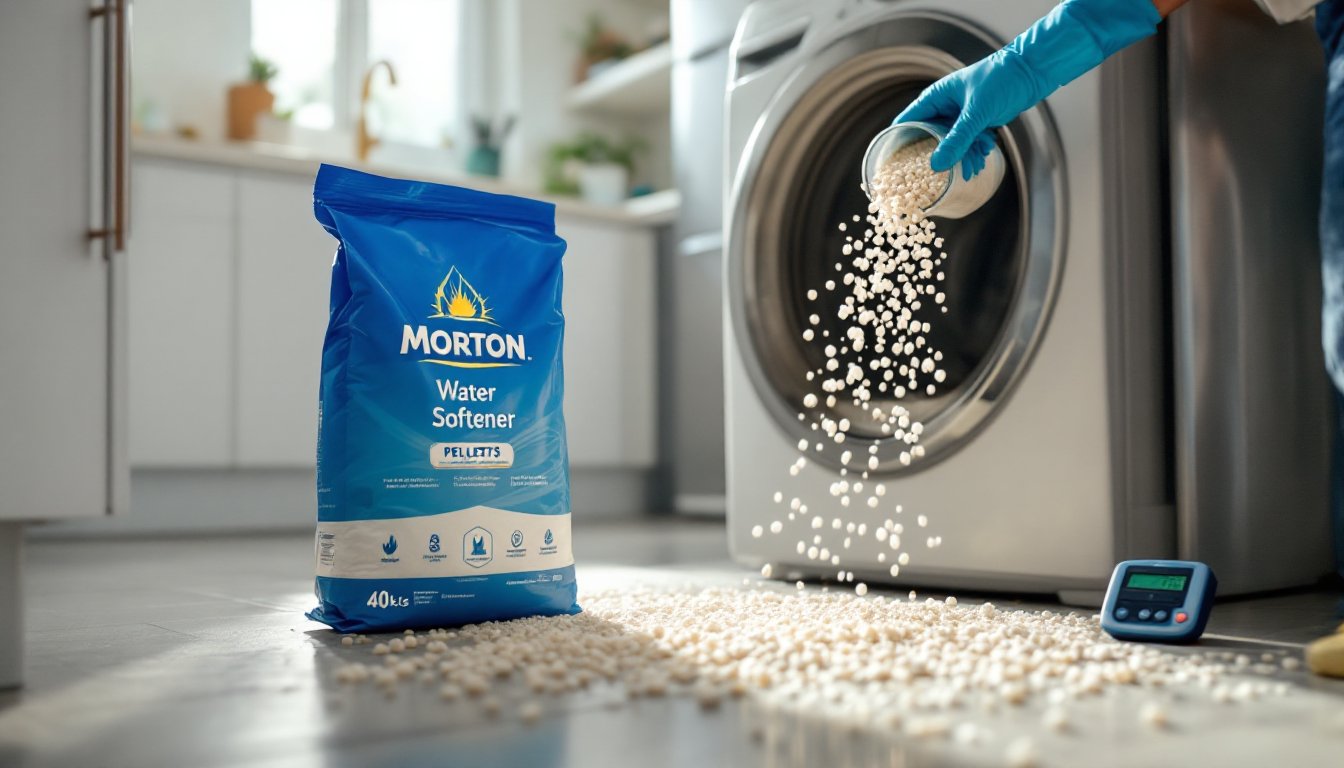
Add salt slowly. Pour or drop salt into the brine tank until it reaches the recommended level (usually marked on the tank). Morton pellets flow smoothly from bags: crystals may require a funnel to avoid spillage.
-
Monitor monthly. Check salt levels every 4–6 weeks. In winter or heavy-use periods, you might refill more often. In mild climates or low-use homes, every 8 weeks is normal.
-
Drain the brine tank annually. Once a year, use a hand pump or wet/dry vacuum to remove standing brine water and residual salt waste. This prevents odor and improves efficiency.
One 40-pound bag of Morton pellets typically lasts 4–6 weeks in a household of four with moderately hard water. Adjust frequency based on your hardness test and usage patterns.
Common Mistakes and How to Avoid Them
Homeowners often sabotage their water softeners without realizing it. Here’s what to avoid:
Ignoring salt level warnings. If your softener has a low-salt alert light, don’t dismiss it. Regenerating without adequate salt leaves hard minerals on the resin, and the system fails to soften water. You’ll notice hardness returning within days.
Mixing salt types. Switching between crystals, pellets, and blocks mid-cycle can create clogs and uneven brine distribution. Pick one type and stick with it unless your manual explicitly approves mixing.
Overfilling the tank. Salt needs room for water to flow and brine to form. Packing the tank to the brim prevents proper regeneration. Follow the tank’s max-fill line, usually 3 feet below the lid.
Skipping the water test. Without knowing your hardness level, you can’t choose the right system capacity or salt quantity. A $15 test prevents years of guessing.
Using rock salt from agricultural suppliers. It’s cheap but contains clay and dirt that clog systems. Spend the extra money on water-softener-grade salt like Morton: it’s purified and safe for your equipment. Top-rated water softener salts are tested for purity and performance.
Proper water softener salt selection depends on understanding your hardness level and system design. Check your manual, test your water, and don’t rush the process.